
Worried About Radon? Get a Clear Answer — and a Mitigation System That Works.
NRPP- and NRSB-certified radon testing and mitigation across Wisconsin. We measure your home's level, explain what it means, and install a system that brings it below the EPA's 4.0 pCi/L action level. Free quote in minutes.
- ✓ NRPP + WI DHS Certified Partner Network
- ✓ Free Quotes · No Upfront Cost
- ✓ Wisconsin Statewide Coverage
Who provides radon mitigation in Wisconsin?
Wisconsin Radon Experts connects Wisconsin homeowners with NRPP-certified radon mitigation specialists. A typical sub-slab depressurization system runs $800–$2,500 with 50–99% radon reduction, and we route your request to a qualified local partner contractor. Free quote within 24 hours. Call (414) 710-2383.
A statewide radon lead-routing network for Wisconsin homeowners.
Wisconsin is unusual: the state has no radon contractor licensing program. The Wisconsin DHS lists roughly 94 NRPP-certified professionals statewide (about 150 when NRSB credentials are included), but they're spread thinly across 17 Radon Information Centers covering all 72 counties. We connect you with a vetted, nationally-certified specialist in your area — and route your project within 24 hours.
Wisconsin Radon Experts is a lead-routing service. All actual radon testing and mitigation work is performed by independent NRPP- or NRSB-certified partner contractors under their own insurance. Because Wisconsin has no state radon license to fall back on, we verify national NRPP or NRSB credentials before any project is routed.
How Much Does Radon Mitigation Cost in Wisconsin in 2026?
The honest answer: most Wisconsin residential mitigation lands between $1,000 and $2,500 installed, including post-mitigation verification testing. Milwaukee and Madison projects tend to cluster at the $1,500–$2,000 mark; older block-wall basements and complex foundations push toward $2,500–$4,000. Here are the cost ranges that cover the overwhelming majority of Wisconsin projects.
| Project Type | Typical Home Size | Installed Cost | Lead Time |
|---|---|---|---|
| Active sub-slab depressurization (standard) | Single-family, full basement | $1,000 – $2,200 | 1–3 weeks |
| Sub-membrane (crawl space) | Single-family, crawl | $1,500 – $3,500 | 1–3 weeks |
| Block-wall depressurization | Older home (pre-1980) | $2,000 – $4,000 | 2–4 weeks |
| Real estate closing mitigation (WB-3 disclosure) | Any single-family | $1,200 – $2,500 | 7–14 days (expedited) |
| Sump pump radon integration | Home with existing sump | $800 – $1,800 | 1–3 weeks |
| Multi-family / condo unit | Per unit | $1,400 – $3,500 | 3–6 weeks |
| Licensed child care center (DCF 250.06 compliance) | Per occupied lower level | $1,500 – $4,500 | 2–5 weeks |
| Commercial building | Office / retail | $2,500 – $15,000+ | 4–8 weeks |
🆓 Haven't tested your Wisconsin home yet? Get a free or low-cost test kit first.
Wisconsin homeowners can request a free or low-cost radon test kit from one of 17 Wisconsin Radon Information Centers operated through the Wisconsin Department of Health Services. Call the statewide hotline at 1-888-LOW-RADON (888-569-7236) to find your nearest center. If your test comes back at or above 4.0 pCi/L, that's when Wisconsin Radon Experts steps in and connects you to an NRPP/NRSB-certified mitigation specialist below.
How Does the Wisconsin Radon Mitigation Process Work?
- Submit a free quote request — online form or phone call to (414) 710-2383. We capture your home details, county, and timeline.
- Lead qualification — we confirm Wisconsin homeowner status, project scope, and timing before routing to a partner contractor.
- Credential verification — because Wisconsin has no state radon license, this step matters more than in most states. We confirm active NRPP or NRSB certification directly with the issuing body before routing your project.
- Partner routing — within 4 business hours, your project goes to the nationally-certified partner contractor serving your area (or the nearest Radon Information Center region if you're outside our 14 primary cities).
- On-site assessment — partner contractor visits within 2–7 days for a free site evaluation: foundation type, suction-point options, fan exhaust routing, and a radon source assessment specific to your geology (Driftless, Precambrian, glacial-till, or Niagaran dolomite).
- Written quote — itemized estimate covering system design, materials, install, and post-mitigation verification testing. Most quotes return within 48 hours of the site visit.
- Schedule install — typical Wisconsin lead time is 1–3 weeks from accepted quote. Real estate closings under Wis. Stat. § 709.03 can be expedited to a 7–14 day turnaround when a WB-3 contingency is in play.
- System installation — typical 4–8 hour install day for sub-slab depressurization. Sub-membrane crawl space systems and Door County stilt-construction homes can take 1–2 days.
- System activation + initial monitoring — fan activated, manometer installed for ongoing system status visibility.
- Post-mitigation verification test — 48–96 hour test starting 24+ hours after activation. WI DHS recommends verification within 30 days of activation; EPA recommends confirmation that radon dropped below 4 pCi/L.
- Final report + warranty — partner contractor provides written verification with pre/post pCi/L documentation and warranty terms (typically 5-year fan, lifetime piping).
Test First, Then Choose the Right Mitigation Method for Your Home
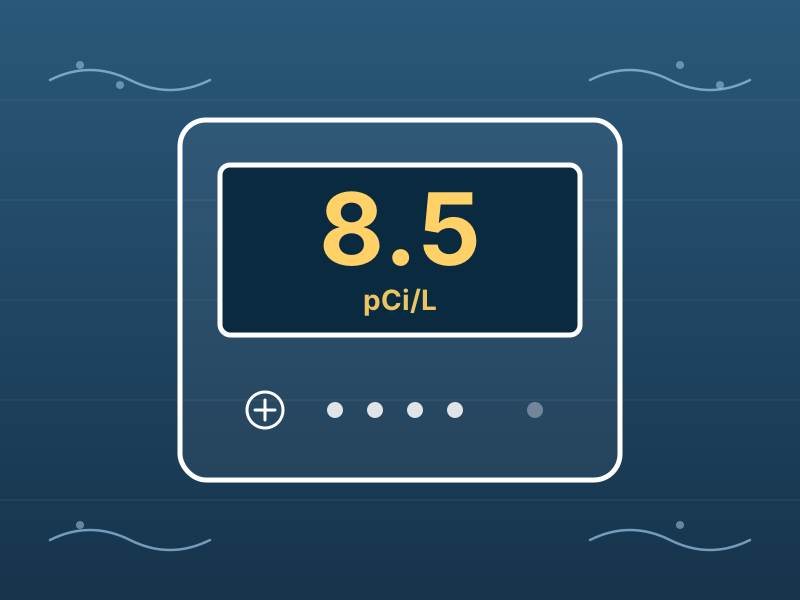
Radon Testing
Step 1 for every Wisconsin homeowner. Professional testing, real estate transaction tests, and post-mitigation verification. Free or low-cost kits available through Wisconsin Radon Information Centers. If your reading is below 4.0 pCi/L, you may not need mitigation at all.
Learn more →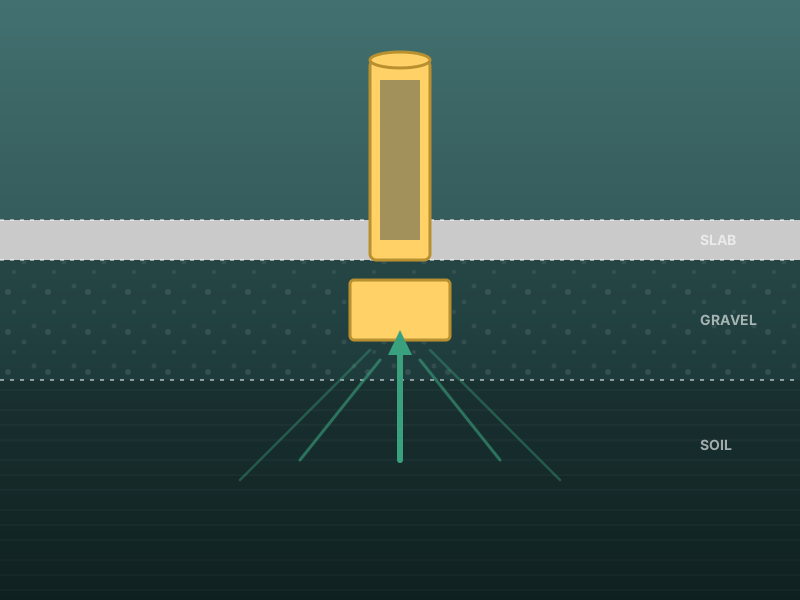
Sub-Slab Depressurization Installation
The standard method for homes with a basement — used in roughly 75–80% of Wisconsin mitigation installs. A small pipe runs from beneath your basement slab, up through the home, and vents radon above the roofline.
Learn more →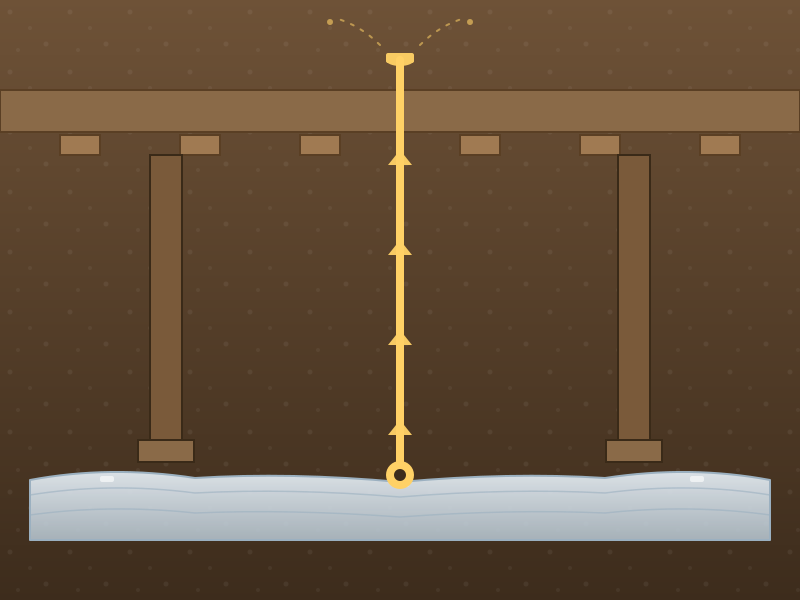
Crawl Space Radon Mitigation
For Wisconsin homes with a crawl space instead of a full basement (common in Door County, older lake-country housing, and some Driftless Area builds). A heavy-duty vapor barrier seals the floor, then an active fan vents radon above the roof.
Learn more →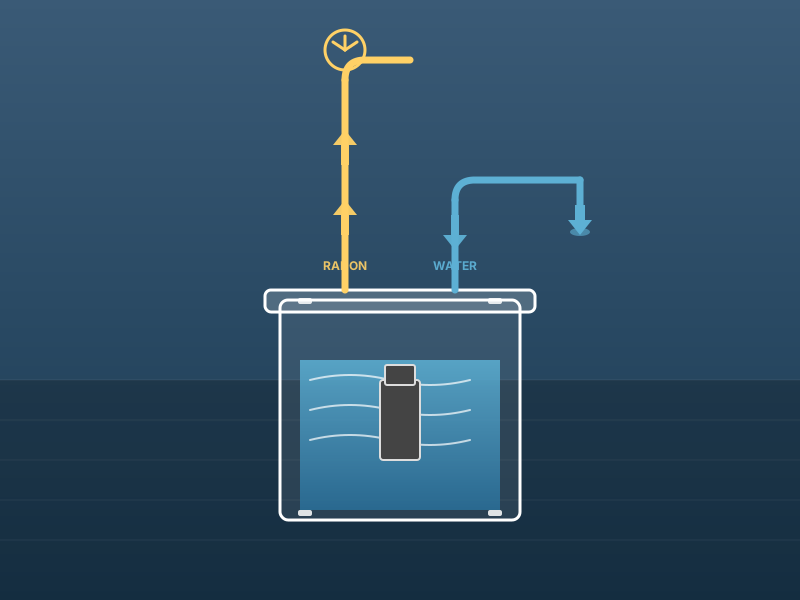
Sump Pump Radon Integration
Already have a sump pump? Often the most cost-effective mitigation — your existing sump basin doubles as the suction point, no need to drill a new hole in your slab. Common in Wisconsin homes built after 1990, especially in flood-prone basements.
Learn more →Not sure which mitigation method fits your home? In Wisconsin, your foundation type answers most of it — basement homes use sub-slab depressurization, crawl-space homes use sub-membrane systems, and homes with an existing sump pump can often integrate the mitigation system into the sump for a lower install cost. Submit a free quote and a partner contractor will assess your home and recommend the right method.
Six Reasons Wisconsin Homeowners Use Our Network
NRPP + NRSB Credential Verification
Wisconsin is one of the few states with no radon contractor licensing program — meaning national NRPP or NRSB certification is the only quality marker that exists. We verify active credentials directly through nrpp.info or nrsb.org before any partner is routed work in our network.
Dual-Geology Expertise
Wisconsin's radon comes from two very different sources: the Driftless Area's uranium-bearing Cambrian sandstone in the southwest, and Precambrian granite in the north-central counties around Wausau. Our partner contractors design suction points and venting around the geology specific to your county — not a generic template.
4-Hour Response Standard
Submit your quote request and a certified partner contractor in your area responds within 4 business hours. No phone tag, no three-day silence — especially important when a real estate transaction is on a 10-day WB-3 disclosure clock.
Real Estate Condition Report Ready
Wis. Stat. § 709.03 requires sellers to deliver the Real Estate Condition Report (Form WB-3) within 10 days of accepting an offer, and to disclose any known prior radon test results. Our partner network handles closing-timeline mitigations — test, install, and verify within typical 30-day contingency windows.
DCF 250.06 Child Care Compliance
Wisconsin Admin. Code § DCF 250.06(6)(a) (March 2023) is Wisconsin's only mandatory radon testing law — licensed child care centers cannot have radon levels above 4 pCi/L in any lower-level space used by children at least 7 hours per week. Our partner network handles testing, design, install, and the documentation required for licensing renewal.
Statewide Wisconsin Coverage
14 city service areas: Milwaukee, Madison, Green Bay, Kenosha, Racine, Appleton, Waukesha, Eau Claire, Oshkosh, Janesville, West Allis, La Crosse, Sheboygan, and Wausau — plus statewide partner-network reach into all 72 counties via the WI DHS Radon Information Center system.
Common Wisconsin Radon Questions
Cost, how a system is installed, what it costs to run, radon levels, real estate, permits, and choosing a contractor — every question answered in one place.
Read the Full Radon FAQ →Wisconsin Service Areas We Cover
Wisconsin Radon Experts routes radon mitigation requests to NRPP-certified, NRSB-certified partner contractors across 14 Wisconsin cities, with statewide partner coverage available. Click any city for location-specific radon data — county averages, EPA zone classification, and local geology.
Get a Free Wisconsin Radon Quote in 24 Hours
Call (414) 710-2383 for same-day routing to an NRPP- or NRSB-certified Wisconsin partner, or submit a quote request online. Quote response within 24 hours. Free on-site assessment. No upfront cost.
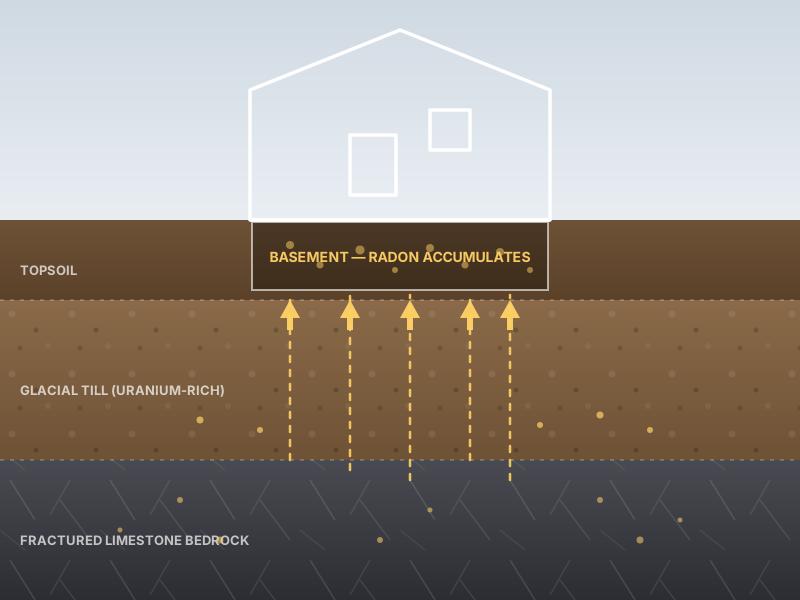
Why Does Wisconsin Have Such Elevated Indoor Radon?
Most national radon coverage treats Wisconsin as a quiet middle-of-the-pack state. The data tells a different story: every one of Wisconsin's 72 counties is classified EPA Zone 1 or Zone 2 — the state has no low-risk Zone 3 counties — and roughly 1 in 10 homes test above the 4 pCi/L action level, with far higher rates in hotspots like Marathon County. The reason isn't one geological story — it's two, layered on top of a six-month heating season.
- The Driftless Area (southwestern Wisconsin) shares Iowa's radon geology. Iowa, Lafayette, Grant, Crawford, Vernon, Richland, Sauk, Trempealeau, and La Crosse counties sit in the Driftless Area — the four-state pocket (WI, IA, MN, IL) that escaped Pleistocene glaciation. The same uranium-bearing Cambrian sandstone and Ordovician carbonate bedrock that earned Iowa its national-leading radon ranking outcrops here. The Mississippi River doesn't stop the geology.
- Precambrian granite drives the Wausau hotspot. North-central Wisconsin sits on Precambrian granite and metamorphic bedrock with its own uranium content — a completely separate radon source from the Driftless story. Marathon County Health Department reporting indicates roughly two out of every three tested homes return elevated readings, with routine measurements above 20 pCi/L and outliers above 100 pCi/L. Wood, Lincoln, and Portage counties share the same bedrock signature.
- Glacial till blankets the eastern two-thirds of the state. From Milwaukee north through Green Bay and Sheboygan, glacial-till deposits transport radon from underlying bedrock into basement-construction homes. Permeability varies, but tested-home averages routinely exceed the EPA action level in Zone 2 counties that the federal zone map would predict to be safe.
- Niagaran dolomite drives the Door County peninsula. Fractured Niagaran dolomite under the Door peninsula is specifically flagged by WI DHS as an elevated-radon region — a localized story that doesn't show up in any of the broader bedrock categories.
- Wisconsin's cold winters multiply everything. Madison's January overnight lows sit around 9°F; Milwaukee around 16°F; Wausau routinely sub-zero. For roughly six months a year, heated indoor air rising through Wisconsin basements creates negative pressure that pulls soil gas — including radon — into the home through cracks, slab penetrations, and block walls. Winter readings typically test 30–50% higher than summer readings.
The result: roughly 1 in 10 Wisconsin homes test elevated statewide — but that average masks a much sharper regional picture. The Wisconsin Radon Program reports that 46% of ZIP codes have at least half their tested homes returning elevated results. The right question isn't whether Wisconsin homes test high in the abstract; it's whether your county, ZIP code, and foundation type put you in the elevated band.
📞 Get a Free Radon QuoteHow High Are Radon Levels in Your Wisconsin County?
Across Wisconsin's 72 counties, every one is classified EPA Zone 1 (highest risk) or Zone 2 (moderate) — there are zero Zone 3 counties in the state. The table below lists the Wisconsin cities we serve where county- or city-level tested averages are published, sorted from highest to lowest. Note that several Zone 2 counties (Milwaukee, Racine, Sheboygan) test well above the action level on a tested-home basis — meaning EPA zone alone doesn't predict your home's risk.
| City | County | Average pCi/L | % Homes Elevated | EPA Zone |
|---|---|---|---|---|
| Wausau | Marathon County | 11.6 | 67% | Zone 1 |
| Waukesha | Waukesha County | 6.4 | 60% | Zone 1 |
| Janesville | Rock County | 6.4 | — | Zone 1 |
| Oshkosh | Winnebago County | 6.2 | — | Zone 2 |
| Appleton | Outagamie County | 6 | — | Zone 2 |
| Racine | Racine County | 5.8 | — | Zone 2 |
| Green Bay | Brown County | 5.5 | — | Zone 2 |
| Eau Claire | Eau Claire County | 5.2 | — | Zone 2 |
| Milwaukee | Milwaukee County | 4.8 | — | Zone 2 |
| Madison | Dane County | 4.8 | 40% | Zone 1 |
| West Allis | Milwaukee County | 4.8 | — | Zone 2 |
| Kenosha | Kenosha County | 4.7 | — | Zone 2 |
| Sheboygan | Sheboygan County | 4.4 | — | Zone 2 |
| La Crosse | La Crosse County | 4.2 | — | Zone 2 |
Which Radon Mitigation System Is Right for Your Wisconsin Home?
Five mitigation methods cover the overwhelming majority of Wisconsin homes. Foundation type drives the choice, and Wisconsin's housing stock leans heavily toward full basements — though crawl-space construction shows up in northern counties, and Door County's peninsula has its own share of stilt and ledge-construction homes. Your partner contractor confirms the right system during the initial on-site assessment.
| System Type | Foundation Match | Typical Cost | Effectiveness | Best For |
|---|---|---|---|---|
| Active Sub-Slab Depressurization (ASD) | Poured-concrete basement | $1,000 – $2,200 | 70–99% reduction | Most Wisconsin homes (~75–80% use this) |
| Sub-Membrane Depressurization | Crawl space | $1,500 – $3,500 | 70–95% reduction | Crawl-space homes (more common in N. Wisconsin) |
| Block-Wall Depressurization | Hollow block-wall foundation | $2,000 – $4,000 | 60–90% reduction | Older Milwaukee, Madison, La Crosse homes (pre-1980) |
| Drain-Tile Depressurization | Homes with perimeter drain tile | $1,500 – $3,500 | 70–95% reduction | Newer Wisconsin homes with interior drain systems |
| Passive System Retrofit | New construction with passive stub | $700 – $1,800 | 40–70% reduction | Activating builder-installed passive stacks (rare in WI) |
How Does a Radon Mitigation System Actually Work?
A radon mitigation system creates negative pressure beneath your home's foundation, intercepting radon gas from Wisconsin's uranium-bearing bedrock and glacial-till soils before it enters your living space. Whether the source is Driftless Area Cambrian sandstone or north-central Precambrian granite, the engineering is the same. The 4-step infographic below shows exactly how the system protects your home 24/7.
Commercial, Multi-Family, and Real Estate Radon Services
Our partner network includes specialists certified for higher-complexity radon scenarios beyond standard single-family mitigation — including the only category of Wisconsin building required by state code to maintain radon below 4 pCi/L.
Licensed Child Care Centers (DCF 250.06)
Wisconsin Admin. Code § DCF 250.06(6)(a), effective March 2023, is Wisconsin's only mandatory radon testing law. Licensed child care centers cannot operate spaces used by children for 7+ hours per week with radon levels above 4 pCi/L. Partner network handles testing, mitigation design, install, and DCF documentation.
Multi-Family Buildings
Apartment buildings, condos, and townhome developments require unit-by-unit testing and building-scale mitigation design. Partner contractors hold AARST-ANSI Multi-Family Measurement (MFM) and Multi-Family Mitigation (MFMT) credentials — particularly relevant for Milwaukee, Madison, and Green Bay's dense rental stock.
HUD Compliance Projects
Federally-funded multi-family housing must meet HUD radon testing and mitigation standards. Our partner network handles compliance testing, mitigation design per HUD specifications, and required documentation for ongoing federal funding tied to Wisconsin HUD properties.
New Construction (Voluntary RRNC)
Wisconsin has no statewide Radon-Resistant New Construction code, but building passive mitigation into the foundation during construction is dramatically cheaper than retrofitting later. Partner specialists work directly with Wisconsin builders on voluntary RRNC-spec foundations across the Driftless and Wausau regions where the source geology matters most.
Real Estate Transactions (WB-3)
Pre-purchase testing, sell-side disclosure under Wis. Stat. § 709.03 and the Form WB-3 Real Estate Condition Report, and closing-timeline mitigation — typical 7–14 day turnaround from test to verified install. The 10-day WB-3 disclosure window after offer acceptance makes speed essential.
Vapor Intrusion Remediation
Brownfield sites and commercial buildings on contaminated land require sub-slab depressurization paired with vapor intrusion controls. Partner network includes specialists certified for combined radon + VOC mitigation — relevant for Milwaukee and Racine industrial-zone redevelopment.
Read Our Complete Wisconsin Radon Guides
Deep-dive guides on every aspect of radon mitigation in Wisconsin — from how systems work to vetting NRPP-certified contractors.
Radon Mitigation System — Complete 2026 Guide
How systems work, what equipment Wisconsin uses, and what it costs.
Read the complete guide → 🎨 With Animated DiagramHow Does Radon Mitigation Work?
Cross-section diagram of soil gas flow, fan operation, and venting.
See the diagram → 💰 PricingWisconsin Radon Mitigation Cost in 2026
Typical Wisconsin cost: $1,000–$2,500. City-by-city pricing breakdown.
See Wisconsin pricing → ⚠️ Health RiskIs Radon Dangerous? Health Risks Explained
Why radon is the #2 cause of lung cancer — and why 1 in 10 Wisconsin homes face elevated exposure.
Understand the risk → 🔧 Technical Deep-DiveSub-Slab Depressurization (ASD)
Wisconsin's #1 mitigation method — used in ~75–80% of installs.
Technical guide → 📊 Decision GuideRadon Testing vs Radon Mitigation
When to test, when to mitigate, and what each costs.
Compare options → ⚖️ Wisconsin LegalDIY vs Professional Radon Mitigation
Why DIY radon mitigation almost always backfires in Wisconsin — and what to do instead.
Read the comparison → ✅ Buyer GuideHow to Choose a Wisconsin Radon Contractor
Credentials to require, red flags to spot, questions to ask.
Vet contractors → 🏠 For RealtorsWisconsin Realtor Resources
Wisconsin disclosure law, closing-timeline mitigation, the real estate process.
Realtor resources →